
Saif Rasool1, Afaq Ahmad 2 and Mohammad Ashraf2*
1Centre of Excellence in Solid State Physics, University of the Punjab, Lahore, Pakistan; saifrasool55@gmail.com
2Centre of Excellence in Solid State Physics, University of the Punjab, Lahore, Pakistan; aafaq.cssp@pu.edu.pk
PJEST. 2023, 4(3); https://doi.org/10.58619/pjest.v4i3.107 (registering DOI)
Received: 06-April-2023 / Revised and Accepted: 14-June-2023 / Published On-Line: 28-June-2023
ABSTRACT: The Pd (Photodetachment) of a hydrogen molecular negative ions near a soft reflecting wall is being investigated theoretically, focusing on the differential and total Pd.CS (Photodetachment Cross Section) when the laser polarisation is along the molecular axis of the ion. Quantum interference becomes evident on the observable plane when the two components of the electron wave superimpose at a considerable distance and propagate outward. The investigation of these interferences contributes to improving our understanding of the structure of diatomic molecular negative ions. Wall-induced fluctuations are observed in the detached electron spectra. As the distance between the ion and wall (R) increases, the wall effect diminishes, and the results approach those of the Ions in free space, the oscillation amplitude in the Pd.CS decreases, and their frequency increases as both Walls (R) and the distance between the two opposing ion centers (d) increase. The oscillations eventually cease to exist, and the CS (cross-section) exhibits uniform behavior at tremendous values of R and resulting in the match to the Ions in free space.
Keywords: Pd. (Photodetachment), Wall-induced Oscillations, CS (Cross Section), Flux,
Introduction:
A required field of study in quantum physics has always been the phenomenon of quantum interactions between tiny elements [1]. In addition to being an incredibly intriguing aspect of physics, the quantum interference of matter waves has a wide range of practical applications. The interference of Pd. electrons from negative Ions is a primary demonstration of this intriguing occurrence. The study of negative Ions has been vital in science in recent years [2]. Negative Ions are used in many different applications [3], particularly in electronegative gases and plasmas, which have many applications in surface processing, atmospheric chemistry, environmental sciences for disposal gas cleaning, and many others [4].
Negative ion research is an essential component of atomic and molecular physics. Negative ions are necessary for food preservation. Due to the effect of electronegative pollutants such as halocarbons on ozone depletion, the significance of this topic is widely acknowledged [5]. In high-voltage technology, electron-attaching gases are often used as insulators [6]. Negative Ions processes are essential in various modern application zones, including gas discharges. The attachment of electrons to molecules in electronegative gases reduces plasma conductivity and electrical current and can cause instabilities [7]. Negative ions can also be employed in the field-effect Transistors and thin film Transistors fabrication processes [8]. Negative-ion electrospray mass Spectrometry is an efficient method for analysing the composition of un-derivatised neutral oligosaccharides [9]. Because of the high vitality of accelerated particles, Van de Graaff electrostatic accelerators, which utilise negative ions, are still helpful in researching the spectra and structures of atomic nuclei [10]. From 1983 to 1992, inductively coupled plasma mass spectrometry was studied to enable the use of negative atomic and molecular Ions for quantitative measurement. The investigation examined the structure of negative ion spectra, their strength in proportion to plasma and detecting parameters, an element interpretive framework, and the effects of structural anions and cations on analysis outcomes [11].
The ability of negative ions to cause positive biochemical changes in humans has been investigated. Breathing in harmful Ion-charged air can reduce stress, induce a joyful mood, and increase serotonin levels. Negative ions can also help the brain receives more oxygen, enhancing energy and alertness. In addition to being negative ions may offer protection against bacteria and toxins in the air, which can be beneficial for those with allergies and may also help to reduce respiratory irritations [12]. Studies have investigated negative ions’ kinetics and surface physics, focusing on photoelectron release in the presence of a magnetic field, electric field, electronic gradient field, or metallic surfaces. Yang et al. [13] analysed the Pd. process near the interface using COT and derived an analytical expression for the Pd.CS. They found that, like an electron in an electric field, the Pd.CS contains a homogeneous background and sinusoidal oscillation. The interface has a significant impact on the Pd. process. Haneef et al. [14] were the first to use TIM to compute the Pd hydrogen negative ion.CS near a wall surface. Using COT, A. Afaq et al. [15] investigated photodetachment when a laser was polarised along the z-axis near an elastic surface. They believed electronic waves travelled from an image of the source beneath the surface, just like outgoing disconnected electron waves from the source. Then, they used TIM to determine the classical action for those paths followed by an electron perpendicular to the surface. They claimed that the curvature к of the surface influences surface effects in the Pd.CS. Their results coincide with the plane wall case when the sphere’s curvature is zero. Du and Delos [16] discussed the Pd.CS in the presence of an electric field. They used a quantum mechanical method to calculate the Pd.CS, employing a stationary-phase estimate and momentum-space wave distribution. Yang et al. [13] analysed the Pd. process near the interface using COT and derived an analytical expression for the Pd.CS. They found that, like an electron in an electric field, the Pd.CS contains a homogeneous background and sinusoidal oscillation. The interface has a significant impact on the Pd process. Haneef et al. [14] were the first to use TIM to compute the Pd hydrogen negative ion.CS near a wall surface. Using COT, A. Afaq et al. [15] investigated Pd. When a laser was polarised along the z-axis near an elastic surface, they believed that electronic waves travelled from a Wang et al. [17] used semiclassical theory and COT to establish a formula for calculating the Pd.CS in a microcavity. When an electron wave propagates in a closed orbit, the microcavity causes substantial oscillation in the Pd. CS. They show that the Pd.CS is greatly influenced by negatively charged ion orientation and polarisation angle. The Pd.CS peak after Fourier transformation correlates to each closed orbit’s length.
Wang De-Hua [18] investigated the Pd.CS of ions close to an interface employs COT and a two-central model. The outcomes reveal that the Pd.CS is affected by the separation between two centres and the distance between molecular ion interfaces. At equilibrium distance and low photon energy, the Pd.CS of the near interface is twice that of one of the close interfaces, suggesting that interference is significant for the two centres. The Pd.CS of both interfaces is similar at high photon energies, indicating that the interference effect between their centres has died out. Haneef et al. [1] used a theoretical imaging approach to calculate the Pd.CS and detachment electron flux near a soft reflecting surface. The oscillation highly influences the surface in the spectrum of a detached electron.
As the distance between the ion and a soft reflecting wall approaches infinity, the Pd.CS becomes half the original value when the Ions are close to the wall. Moreover, in free space, the Pd.CS is reduced to a two-centre system. Haneef and colleagues investigated an unnoticed oscillation in the Pd.CS of an ion located close to a soft reflecting wall. The study focused on the behavior of the Pd.CS molecule under a laser beam directed perpendicular to the molecule’s axis of negative ions [3]. The same problem is addressed in this paper. We discuss the Pd.CS of an Ions near a soft reflecting wall surface, where the laser polarisation is parallel to the molecular axis of the negative ion. We report a significant extra oscillation induced in the Pd.CS of an ion near the soft reflecting wall surface. Our research will be beneficial in investigating the structure of diatomic negative ions near the surface and in ion traps.
Theory:
The schematic visualisation for Pd of negative Ions near an ideal reflecting wall with parallel laser polarisation direction is shown in Fig. 1. When laser light falls on the negative ion, the ion absorbs energy from the laser and ejects an extra loosely bound electron. The negative ion and its image behind the soft wall surface are the coherent source of detached electron waves.
The total wave function consists of two parts: one part of electron waves coming directly from the negative ion and another part of electron waves reflecting from the soft wall surface, which appears to come from the image of the negative ion behind the wall surface. The detached electron wave function is treated quantum mechanically to derive further the expression for the detached total and differential Pd.CS.
When a laser beam of specified energy strikes a homo-nuclear diatomic ion, it serves as a source (S) of detached wave electrons, which electrons thought to generate waves correlated with the detached electron. The reflective wall (W) has a soft surface and is positioned perpendicular to the axis of the source along the y-axis.
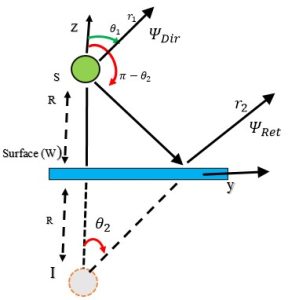
Fig. 1: The schematic representation for Pd of near a soft wall surface with a parallel laser beam. The green circle shows the negative Ions, the grey ring is the image that appears behind the Wall, and (W) indicates the Wall surface.
The source (S) is on the z-axis, while the distance between the source and the soft reflecting wall is R atomic units. The green dotted line shows the orientation of laser polarisation, which is parallel to the z-axis. There are two components to a detached electron wave and , which are represented in Fig. 1. There is a direct part of the wave that comes directly from the source, and the return part of the wave that appears to be reflected from the wall and seems to be coming from the image (I) behind the wall. Let there be a wave associated with a loosely bound electron detached from the source after being absorbed by laser light.
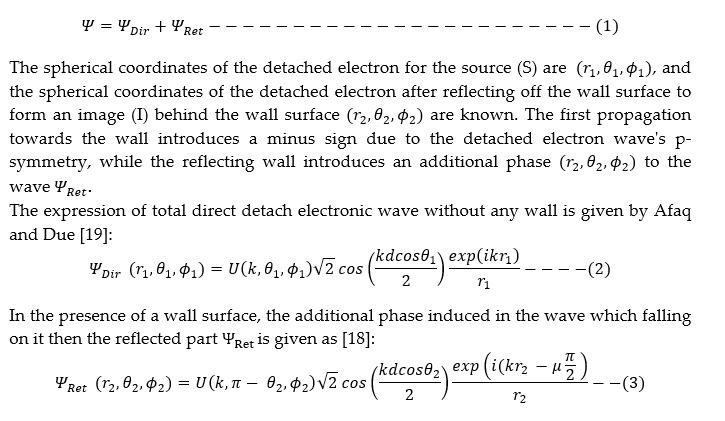
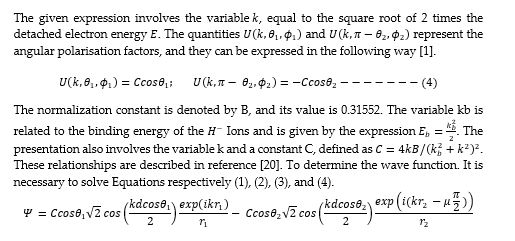
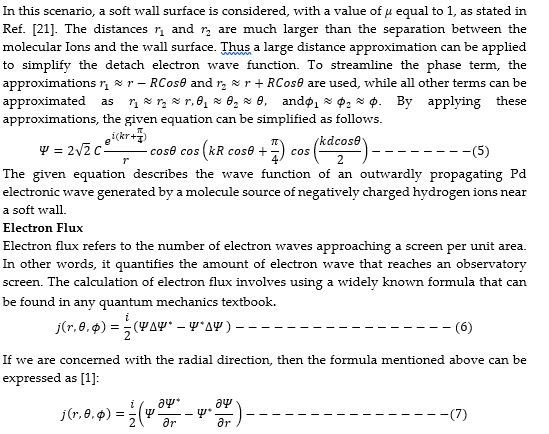
This wave makes an angle with the z-axis. Half of the total wave is not reflected from any wall and goes directly to a considerable distance, making the angle smaller than that with the z-axis. The other portion of the detached electron wave first moves toward the reflecting wall while forming an angle larger than with the z-axis. Following this, the mirrored electron wave from the wall surface moves toward the screen, which is positioned L atomic units away from the system. We can observe that two distances, and , are covered by and , respectively, towards the observatory screen. The observatory screen is placed perpendicular to the diatomic molecular axis. The outgoing detached electronic wave at a considerable distance from the ion is a linear combination of two waves given by [1];
Results and Discussions
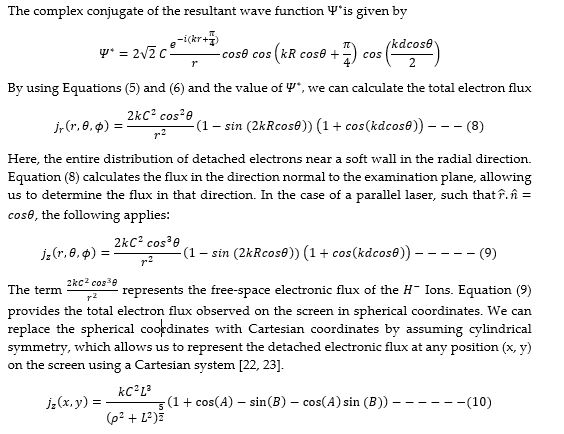
Figure. 2 depicts the detached electron flux pattern for parallel laser light, which was obtained using Eq. (10). The pattern exhibits a strong interference pattern observed at different distances between the wall and Ions (R), and the detached-electron flux is represented in the figure.The interference pattern observed in Fig. 2 is caused by the interference of two detached electron waves, where one electron wave is emitted directly from the source, and the other wave is reflected from the soft wall surface, appearing to originate from the image of behind the wall surface. The interference pattern depends on the values of , where when is an odd integral multiple of half of π, a peak at the centre of the screen is observed due to constructive interference of the two detached electronic waves.
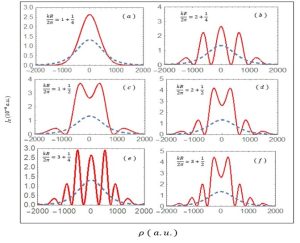
Fig. 2: The distribution of electron flux for the detached electrons of the Ions near the soft wall surface is shown by the solid red line, while the flux of detached electrons of in free space is indicated by the dotted blue line. The parameters L=1000, d=1.14 in atomic units, and are fixed, and different values of parameter R are used, namely: (a) R=60, (b) R=105, (c) R=70, (d) R=117, (e) R=152, and (f) R=164 in atomic units.
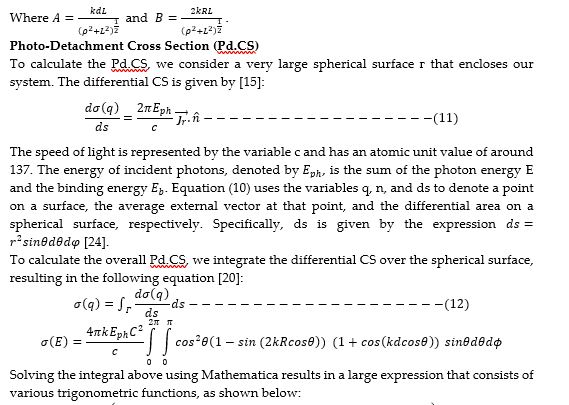
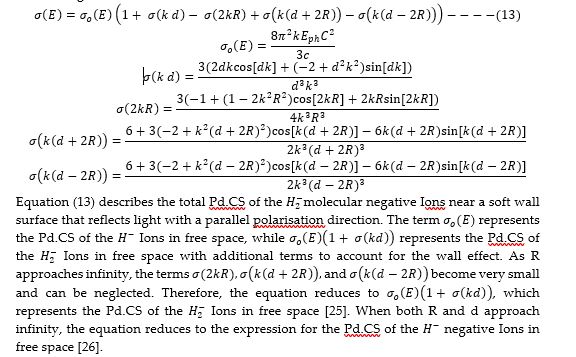
Conversely, when an integral multiple of π, the peaks are not centred, indicating destructive interference. Fig. 2 displays the detached electron flux pattern, exhibiting different peaks at different kR values. Eq. (13) shows that this interference effect is caused by the sizeable trigonometric function terms in the expression, which leads to extra oscillations in the Pd.CS. The total Pd.CS, which is greatly dependent on the distance between the ion and wall R, incidence photon energy, and interatomic distance d, is plotted in Fig. 3.
The large trigonometric functions in the expression produce significant oscillations in the Pd.CS. The red line in the graph represents the Pd.CS of Ions near the soft wall, and the blue dotted line represents the Pd.CS of Ions in free space. At significant photon energy limits, the Pd.CS of Ions near the wall approaches that of the Pd.CS of Ions in free space. The soft wall introduces extra oscillations in the Pd.CS for parallel laser polarisation. We plot the graph for different values of R, ranging from 10 to 1000 atomic units, and observe that the extra oscillations induced by the wall decrease as the distance between the Ions and Wall (R) increases.
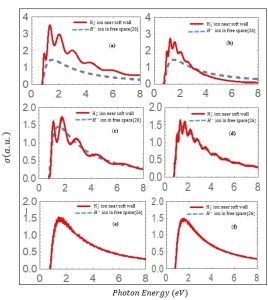
Fig. 3: Comparison between the Pd.CS of the homo-nuclear diatomic hydrogen
As the distance, R, between the Ions and the wall increases, the amplitude of the extra oscillation decreases, but there is a simultaneous increase in the oscillation frequency. The additional oscillations in Pd.CS is reduced to almost zero in a considerable distance between the Ions and Wall. In this scenario, the system behaves as if it is in free space, as the reflected wall effect becomes negligible. This decrease in the Pd.CS can be attributed to the absence of the reflected wall effect. This phenomenon has been previously reported in reference [25].
When the distance between the two centers (d) in a negative molecular Ions becomes very large, the Ions dissociate into an Ions. As a result, the interference effect due to two centres on the total cross-section disappears, leading to non-oscillatory behavior [26]. In this scenario, the total, partial cross-section approaches that of a single centre hydrogen negative Ions in free space. This observation highlights the importance of the distance between the centers on the behavior of negative molecular Ions.
Conclusion
In the above discussion, we discuss the analysis of oscillations in the Pd. Sy spectra of a diatomic molecular negative Ions ( ) near a soft surface using a TIM are summarised. A soft surface induces a significant interference pattern in the detached electron flux. The value of kR determines the interference pattern observed in the electron flux spectra during Pd. When kR is an odd integral multiple of half of π, it leads to constructive interference and centred peaks. However, when kR is an integral multiple of π, it results in destructive interference and off-centred peaks. It was found that the Pd.CS of Ions near the soft wall are more significant than the CS of Ions in space, as reported in previous research [25].
The study showed that when the laser polarisation is parallel to the molecular axis of Ions near the soft wall, it causes significant oscillations in the Pd.CS. Furthermore, the study examined the impact of the inter-ion surface distance on the overall Pd.CS and discovered that the amplitude of oscillations decreased as the distance between the Ions and Wall increased. For tremendous values of R, the result is identical to that of the negative Ions in free space. In addition to the amplitude of oscillations in the Pd.CS decreases, and their frequency increases as the distance between the Ions and Wall (R) and the inter-atomic distance (d) growth. The oscillations cease to exist, and the CS exhibits smooth behavior at tremendous values of R and d, which is the same as that of the Ions in free space. The result of this study can offer essential insights for investigating the structure and dynamics of negative diatomic molecular Ions. The authors hope that this result will guide future experiments involving the Pd. of negative Ions near soft surfaces, cavities, and Ion traps.
Author’s Contribution: M.A. conceived the idea, designed the simulated work, and acquired the data. M.A. and A.A. executed the simulated work, analysed and interpreted the data, and wrote the initial draft. A.A. and S.R. provided language and grammatical edits and made critical revisions.
Funding: This article was not funded by any organisation.
Conflicts of Interest: The authors have declared that they do not have any conflicts of interest.
Acknowledgement: The author would like to thank Mr. Afaq Ahmad for his assistance with the collection of data.
References
[1] M. Haneef, S. Arif, J. Akbar, M. Zahir, and N. Shah, “PHOTODETACHMENT OF NEAR A SOFT REFLECTING SURFACE,” Journal of Theoretical and Computational Chemistry, vol. 12, no. 03, p. 1350010, 2013.
[2] A. Rahman, I. Ahmad, A. Afaq, M. Haneef, and H. Zhao, “Investigation of Linear Tetra-Atomic Negative Ion by Photodetached-Electron Spectra,” Chinese Physics Letters, vol. 28, no. 8, p. 083301, 2011.
[3] M. Haneef, S. Arif, J. Akbar, M. Zahir, N. Shah, and K. Abid, “Investigation of invisible oscillation on the photodetachment cross-section of H near a hard surface,” Pramana, vol. 81, no. 1, pp. 117-126, 2013.
[4] E. Stoffels, W. Stoffels, and G. Kroesen, “Plasma chemistry and surface processes of negative ions,” Plasma Sources Science and Technology, vol. 10, no. 2, p. 311, 2001.
[5] Heinlin, J., Isbary, G., Stolz, W., Morfill, G., Landthaler, M., Shimizu, T., … & Karrer, S. (2011). Plasma applications in medicine with a special focus on dermatology. Journal of the European Academy of Dermatology and Venereology, 25(1), 1-11.
[6] L. G. Christophorou and R. J. Van Brunt, “SF/sub 6//N/sub 2/mixtures: Basic and HV insulation properties,” IEEE Transactions on Dielectrics and Electrical Insulation, vol. 2, no. 5, pp. 952-1003, 1995.
[7] N. L. Aleksandrov and A. P. Napartovich, “Phenomena in gases and plasmas with negative ions,” Physics-Uspekhi, vol. 36, no. 3, p. 107, 1993.
[8] M. Ishikawa et al., “miRNA-based rapid differentiation of purified neurons from hPSCs advancestowards quick screening for neuronal disease phenotypes in vitro,” Cells, vol. 9, no. 3, p. 532, 2020.
[9] W. Chai, V. Piskarev, and A. M. Lawson, “Negative-ion electrospray mass spectrometry of neutral underivatised oligosaccharides,” Analytical chemistry, vol. 73, no. 3, pp. 651-657, 2001.
[10] G. Dimov, “Use of hydrogen negative ions in particle accelerators,” Review of scientific instruments, vol. 67, no. 10, pp. 3393-3404, 1996.
[11] A. Pupyshev and V. Surikov, “Application of negative ions in inductively coupled plasma-mass spectrometry,” Spectrochimica Acta Part B: Atomic Spectroscopy, vol. 59, no. 7, pp. 1021-1031, 2004.
[12] G. Tom, M. F. Poole, J. Galla, and J. Berrier, “The influence of negative air ions on human performance and mood,” Human Factors, vol. 23, no. 5, pp. 633-636, 1981.
[13] G. Yang, Y. Zheng, and X. Chi, “Photodetachment of H− in a static electric field near an elastic wall,” Physical Review A, vol. 73, no. 4, p. 043413, 2006.
[14] M. Haneef, I. Ahmad, A. Afaq, and A. Rahman, “Photodetachment of H− near a hard spherical surface,” Chinese Physics Letters, vol. 29, no. 1, p. 013202, 2012.
[15] A. Afaq, A. Iqbal, A. Iftikhar, and M. Asif, “Photodetachment spectrum of hydrogen negative ion near a spherical surface,” Canadian Journal of Physics, vol. 94, no. 2, pp. 226-230, 2016.
[16] M. Du, “Closed-orbit theory for photodetachment of H− in a static electric field,” Physical Review A, vol. 70, no. 5, p. 055402, 2004.
[17] D.-h. Wang, S.-S. Li, Y.-h. Wang, and H.-f. Mu, “Semiclassical calculation of the photodetachment cross section of hydrogen negative ion inside a square microcavity,” Journal of the Physical Society of Japan, vol. 81, no. 11, p. 114301, 2012.
[18] W. De-Hua, “Photodetachment of a negative hydrogen molecular ion near an interface,” Chinese Physics Letters, vol. 24, no. 2, p. 400, 2007.
[19] A. Afaq and D. Meng-Li, “Interferences in Photodetachment of a Negative Molecular Ion Model,” Communications in Theoretical Physics, vol. 50, no. 6, p. 1401, 2008.
[20] A. Afaq and D. Meng-Li, “Interferences in photodetachment of a negative molecular ion,” Communications in Theoretical Physics, vol. 46, no. 1, p. 119, 2006.
[21] A. Afaq and M. Du, “A theoretical imaging method for the photodetachment of H− near a reflecting surface,” Journal of Physics B: Atomic, Molecular and Optical Physics, vol. 40, no. 6, p. 1309, 2007.
[22] W. De-Hua, “Electric flux distribution in photodetachment of heteronuclear diatomic molecular negative ion,” Chinese Physics B, vol. 19, no. 2, p. 020306, 2010.
[23] W. De-Hua, “Electron Flux Distributions in the Photodetachment of H− 2 in an Electric Field,” Communications in Theoretical Physics, vol. 49, no. 6, p. 1591, 2008.
[24] I. Fabrikant, “Spatial distribution of electrons photodetached in an electric field,” Journal of Physics B: Atomic, Molecular and Optical Physics, vol. 23, no. 7, p. 1139, 1990.
[25] A. Afaq and M. Du, “Oscillations in the photodetachment cross section of a two-centre model,” Journal of Physics B: Atomic, Molecular and Optical Physics, vol. 42, no. 10, p. 105101, 2009.
[26] T. Fiyazi and A. Ahmad, “PHOTO-DETACHMENT OF H,” Science International, vol. 25, no. 1, 2013.