
Abdul Moeed Shahid1*, M. Talha Khan1, Zahra Afzaal2, Sadia Shahid3, Farah Javaid4
1Govt. Islamia Graduate College Civil Lines Lahore, Pakistan
2Lahore Grammar School, Main Gulberg, Lahore, Pakistan
3University of Engineering and Technology Lahore, Pakistan
4Govt. APWA College (W) Lahore, Pakistan
Corresponding author email: moeedshahid7@gmail.com, z.afzaal17@gmail.com
PJEST. 2024, 5(2); https://doi.org/10.58619/pjest.v5i2.186 (registering DOI)
Received: 24-June-2025 / Revised and Accepted: 02-July-2025 / Published On-Line: 30-Sept-2025
ABSTRACT: Various research has confirmed that lead causes serious health risks on human. Cyclone separators are highly effective industrial devices used for separating material particles from air. The study investigates the influence of particle size and inlet velocity on the separation efficiency of lead (Pb) particles in a cyclone separator using Computational Fluid Dynamics (CFD). The cyclone separator is designed of a height of 0.11m with an outlet height of 0.0625m, inlet height of 0.15m with depth of 0.1m using ANSYS Fluid Flow. The net particles used is ranged from 1 µm to 9 µm with an inlet velocity of 3 m/s to 8 m/s When operating at an inlet velocity of 3 m/s, the efficiency is lowest at 2.2%, for particles measuring 1 µm, while for 9 µm particles, it reaches a peak efficiency of 95.4%. When operating at an inlet velocity of 8 m/s, the efficiency is lowest at 9.9% for particles measuring 1 µm, while for 9 µm particles, it reaches a peak efficiency of 100%. The Simulation results indicate that the performance of a cyclone separator is influenced by both particle size and inlet velocity and observed as a highly effective tool for the removal of lead (Pb) particles present in air to reduce the breathing problems. By capturing particles before they can disperse into the atmosphere, the device can substantially reduce risks of respiratory problems and related health issues in humans. Cyclone separator plays a vital role in safeguarding human health and balancing the ecosystem.
Keywords: CFD, Cyclone Separator, ANSYS, Inlet velocity, Lead Particles, Efficiency
- INTRODUCTION
Environmental pollution by heavy metals is an alarming global issue. With the modernization of industry and technology, the concentration of heavy metals in air is increasing rapidly. These heavy metals are toxic and has damaging effects on the health of all kinds of life on the Planet. Each year, more than 5.5 million people lose their lives prematurely as a result of air pollution linked to these toxic heavy metals. This figure is about six times higher than the number of deaths caused by malaria. Minimizing exposure to heavy metal air pollution has the potential to save many lives. Heavy metals are non-biodegradable elements having high atomic mass and density. Certain heavy metals, such as iron (Fe) and zinc (Zn), are essential and beneficial to human health. While other heavy metals, such as lead (Pb) and cadmium (Cd), are toxic and pose serious health risks. Separating particulate matter, including lead particles, carries substantial biological consequences, especially regarding respiratory health. Various research has confirmed that lead causes serious health risks on human. Lead is a bluish-grey colored soft metal with an atomic number of 82 and mass of 207.2 a.m.u. It has a high density of 11.34 g/cm3. Lead (Pb) is a non-biodegradable, and inhaling them can cause a range of serious health issues, such as liver and kidney damage, gastrointestinal and hematological damage, cancer, anemia, lower IQ levels, inventiveness among children, and nervous system dysfunction [1-4].
Heavy metals also produce reactive oxygen species (ROS) inside living cells, which damage DNA and proteins, disturbing basic cellular functions. Long-term exposure can lead to epigenetic changes, where gene expression is altered without changing the DNA sequence, and these effects may pass to the next generation. Heavy metal contamination in soil harms microbial life and reduces biodiversity, disrupting natural ecosystems. Moreover, reproductive health is also affected, as lead and cadmium disturb hormonal balance, causing infertility and fetal problems [5-9].
Lahore is facing a serious air pollution crisis, especially in winter when smog levels rise sharply. The city’s Air Quality Index (AQI) often exceeds 300, which is considered hazardous to health. This air contains harmful heavy metals like lead, cadmium, and arsenic, which come from vehicle emissions, construction dust, and industrial waste. These toxic metals enter the human body through breathing and can cause serious health problems, especially in children and the elderly [10].
Cyclone separators are highly effective industrial devices used for separating material particles from air. They are used widely in many industries for removing the solid dust particles, mist, and gas particles from fluid. [11-13]. In modern times, cyclone separators are frequently used as filters and fluid catalytic cracking units [14]. Effective designs of cyclone separators can help to bring down the hovering gravelly exposure, which will safeguard lung function and reduce the possibility of systemic lead poisoning [15]. The advancements in separation technologies not only improve industrial performance, but also help to protect public health and the environment [16]. The cyclone separator has an incontrovertible advantage due to its non-complex geometry, high durability, safety, operating cost, maintenance, environment friendly, and wide range of operating conditions. It can also operate at high temperature and pressure [17]. The cyclone separator, instead of using filters works on the principle of vortex separation [18].

Fig. 1 Cyclone Separators used in industry [19]
The working principle of cyclone separator is the use of centrifugal force for settling the particles [20].
A cyclone separator typically consists of a rectangular inlet through which the gas–solid mixture enters the main body of the unit. The body itself is cylindrical in shape, tapering downward into a conical section. Separated solid particles are discharged from the bottom outlet, while the cleaned gas exits through a central outlet located at the top of the cyclone, as shown in the figure [21].

Fig.2 Schematic Diagram of cyclone separator [22]
When the polluted air enters the cyclone separator, then the circular shape of the cyclone separator forces the particle to move in a circle and under the effect of centrifugal force. As a result, the dust particles assemble at the wall and collect in the collector bin under the action of gravity [23].
Removal efficiency of a cyclone separator is highly influenced by the particle size of dust particles as well as inlet velocity. As the inlet velocity increases, the centrifugal force on dust particles also increases, resulting in the enhancement of filtration efficiency of the cyclone separator. The size of particle also enhances the filtration efficiency of the cyclone separator. Larger particles, due to higher inertia than small particles, are more likely to be collected, hence improving filtration efficiency [24-27].
Due to such importance of efficiency of cyclone separators, many researches and experiments are done in this field of the efficiency of the cyclone separator. In 1997, B. Yücesoy et. al investigated how occupational exposure to lead and cadmium affects immune function in men [28]. In 2005, J. Jiao et. al studied the efficiency of separation and flow field of a dynamic cyclone [29]. In 2005, J. Gimbun et al. studied about the prediction of efficiency of cyclone collection by using CFD [30]. In 2008, M. Mori et. al analyzed the cyclone separators that were connected in series by using Computational Fluid Dynamics (CFD) [31]. In 2016, A. Surjosatyo et. al examined how the vortex binder dimensions affect the performance of a cyclone separator in a biomass gasification system [32]. In 2017, P. K. Ithape et. al used Computerized Fluid Dynamics (CFD) to analyze the impact of various geometric parameters on cyclone separator performance [33]. In 2017, K. Jolly etal studied the Sex-specific impact of lead exposure on the imune-neuroendocrine network in mice [34]. In 2018, H. Saputro et. al conducted an analysis of CFD simulations on cyclone separator equipped with a counter cone in the updraft gasification process [35]. In 2018, S. Wang et. al investigated how the inlet angle influences the performance of the cyclone separator through CFD-DEM [36]. In 2019, D. Misiulia et. al analyzed the efficiency of industrial cyclone separator by using CFD [37]. In 2019, K. K. Arun et. al used CFD technique to analyze the pressure drop in the cyclone separators [38]. In 2019, studied the numerical validation and rough flow in separator by using Commercial CFD Code [39]. In 2019, S. Gençoğlu et. al analyzed the performance of turbulence models of cyclone separators for CFD simulations [40]. In 2020 M. Ebrahimi et. al investigated the impact of lead and cadmium on immune system and the progression of cancer in humans [41]. In 2020, K. Subramanian et. al studied the impact of reducing pressure drop holes on the performance of cyclone separator [42]. In 2021, J. R. Pastran et. al analyzed the performance characterization of new model for cyclone separator of particles using CFD [43]. In 2022, M. Wasilewski et. al analyzed the cyclone separators with various cone shapes and heights by using CFD [44]. In 2023, Y. R. Kang et. al studied the efficiency of cyclone separator with numerical approach [45]. In 2023, T. Dziubak et. al. conducted a numerical analysis to investigate the impact of axial cyclone inlet velocity and geometrical parameters on pressure drop and separation efficiency [46]. In 2024, R. Yadav et. al examined how lead exposure affects DNA in pregnant women [47]. In 2024, T.V. Paganel et al. conducted a study on the CFD Simulation of an industrial dust cyclone separator, comparing it with empirical models. The study focused on the impact of inlet velocity and particle size on Performance Factors in a highly concentrated particle situation [48]. Different researchers use ANSYS and Fuzzy simulation for different researches and get very useful results [49-61].
- SIMULATION
ANSYS is an exceptionally impressive and inventive software for multi-physics simulations. It is usually the most precious and extensive software design that is used to illustrate the cooperation of overarching controls of pulsation, simple and physical skills, warm exchange alongside electromagnetic alteration, and fluid for engineers.
Computational Fluid Dynamics (CFD) is an excellent tool ANSYS provides for multi-physics simulations. In this research, the effect of particle size and inlet velocity on the lead (Pb) particles removal efficiency of a cyclone separator is examined using Computational Fluid Dynamics (CFD). The structural steel is used to design the geometry of the cyclone separator in the designed modeler of the ANSYS workbench. For filtration, the designed cyclone separator consists of 0.11m height and 0.81m width with vertical cylindrical width having a dimension of 0.41m. The outlet of the cyclone separator has a height of 0.0625m and a width of 0.05m. The face of the inlet structure has a height of 0.15m and a width of 0.05m with a depth of 0.1m. The structure of the collector bin where all particles will be gathered has a depth of 0.15 m and a diameter of 0.15 m. The geometry of the cyclone separator is given below

Fig. 3 Geometry of Cyclone Separator
For precision and approximating the real-time results, the geometry of the cyclone separator is finely meshed. The setting used for meshing in this research consists of high smoothing, the relevance center is fine, and the span center is fine. The meshed geometry has 46470 elements, and 9615 nodes in total. The element number can be increased for more precise results, but this exceptional meshing has disadvantages of processing time in simulation. The geometry of the cyclone separator having meshing is given below:
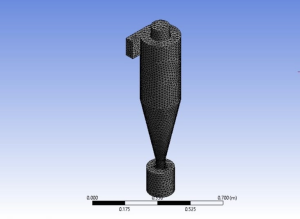
Fig.4 Meshing of Cyclone Separator
The wireframe model of this meshing of cyclone separator is given below:

Fig.5 Wireframe meshing of Cyclone Separator
After properly meshing up the designed geometry, the boundary conditions for the CFD analysis are set. For this research, boundary conditions of this cyclone separator are inlet flow parameters at a velocity of 3 m/s to 8 m/s at the inlet, intensity and hydraulic diameter of 0.067 m, and discrete phase B.C of reflecting type. For the outlet, the backflow hydraulic diameter is 0.1 m with discrete phase B. C of escape type. For wall-solid, wall motion kept stationary and no slip of shear condition with discrete phase B.C of reflect type. For the collector bin, DPM is set on trap type as tabulated in the given table:
Table 1: Position parameters and boundary condition
| Positions parameter | Boundary Conditions |
| Inlet | Velocity inflow
(3m/s-8 m/s) |
| Outlet | Backflow (escape) |
| Wall-solid | Reflecting (no slip) |
| Collector-bin | Wall (trap) |
RESULTS AND DISCUSSIONS
Ansys Fluid Flow (Fluent) is used to filtrate lead particles from the air. The velocity range for this simulation is set from 3 m/s to 8m/s. The particle size ranges from 1 µm to 9 µm. The flow rate for this research is set to be 0.00001 kg/s. The designed cyclone separator is observed as a highly effective tool for the removal of lead (Pb) particles present in air. When operating at an inlet velocity of 3 m/s, its performance varies with particle size. For particles measuring 1 µm, the efficiency is lowest at 2.2%, while for 9 µm particles, it reaches a peak efficiency of 95.4%. The efficiency increases progressively with particle size: 2.2% for 1 µm, 6.4% for 2 µm, 14.2% for 3 µm, 22.6% for 4 µm, 35.6% for 5 µm, 57.4% for 6 µm, 77% for 7 µm, 88.3% for 8 µm, and 95.4% for 9 µm. The graph related to these efficiencies with respect to their particle size at the inlet velocity of 3 m/s is shown in figure:

Graph 1
When operating at an inlet velocity of 4 m/s, its performance varies with particle size. For particles measuring 1 µm, the efficiency is lowest at 2.8%, while for 9 µm particles, it reaches a peak efficiency of 99%. The efficiency increases progressively with particle size: 2.8% for 1 µm, 7.6% for 2 µm, 13.7% for 3 µm, 25.5% for 4 µm, 51.7% for 5 µm, 79.6% for 6 µm, 90.3% for 7 µm, 97% for 8 µm, and 99% for 9 µm. The graph related to these efficiencies with respect to their particle size at the inlet velocity of 4 m/s is shown in figure:

Graph 2
When operating at an inlet velocity of 5 m/s, its performance varies with particle size. For particles measuring 1 µm, the efficiency is lowest at 3.8%, while for 9 µm particles, it reaches a peak efficiency of 100%. The efficiency increases progressively with particle size: 3.8% for 1 µm, 10.3% for 2 µm, 19.7% for 3 µm, 42.1% for 4 µm, 75% for 5 µm, 94.1% for 6 µm, 98.8% for 7 µm, 99.6% for 8 µm, and 100% for 9 µm. The graph related to these efficiencies with respect to their particle size at the inlet velocity of 5 m/s is shown in figure:

Graph 3
When operating at an inlet velocity of 6 m/s, its performance varies with particle size. For particles measuring 1 µm, the efficiency is lowest at 9.7%, while for 9 µm particles, it reaches a peak efficiency of 99.2%. The efficiency increases progressively with particle size: 9.7% for 1 µm, 16% for 2 µm, 24.1% for 3 µm, 51.1% for 4 µm, 86.3% for 5 µm, 96.7% for 6 µm, 99.6% for 7 µm, 99.91% for 8 µm, and 99.92% for 9 µm. The graph related to these efficiencies with respect to their particle size at the inlet velocity of 6 m/s is shown in figure:

Graph 4
When operating at an inlet velocity of 7 m/s, its performance varies with particle size. For particles measuring 1 µm, the efficiency is lowest at 9.8%, while for 9 µm particles, it reaches a peak efficiency of 100%. The efficiency increases progressively with particle size: 9.8% for 1 µm, 17% for 2 µm, 27% for 3 µm, 57.6% for 4 µm, 83% for 5 µm, 96% for 6 µm, 99.4% for 7 µm, 99.6% for 8 µm, and 100% for 9 µm. The graph related to these efficiencies with respect to their particle size at the inlet velocity of 7 m/s is shown in figure:

Graph 5
When operating at an inlet velocity of 8 m/s, its performance varies with particle size. For particles measuring 1 µm, the efficiency is lowest at 9.9%, while for 9 µm particles, it reaches a peak efficiency of 100%. The efficiency increases progressively with particle size: 9.9% for 1 µm, 15% for 2 µm, 29.7% for 3 µm, 64.1% for 4 µm, 90% for 5 µm, 98.4% for 6 µm, 99.7% for 7 µm, 100% for 8 µm, and 100% for 9 µm. The graph related to these efficiencies with respect to their particle size at the inlet velocity of 8 m/s is shown in figure:

Graph 6
The simulation results observed that the filtration efficiency of cyclone separator is highly influenced by the inlet velocity. The efficiency of cyclone separator increases with the increase of inlet velocity. For the particle size of 4 µm, the minimum efficiency of 22.6% is observed for the inlet velocity of 3 m/s, and maximum efficiency of 64.1% for the inlet velocity of 8 m/s. The Graph which illustrates the efficiency is shown in figure:

Graph 7
The Simulation results indicate that the performance of a cyclone separator is influenced by both particle size and inlet velocity. As either the particle size or the inlet velocity increases, the removal efficiency also improves. Larger particles, due to their higher inertia are more easily to separate from the air, leading to increase in filtration efficiency. While particles lower in size are difficult to filter due to lower inertia. As the inlet velocity increases, the centrifugal force on dust particles also increases, resulting in the enhancement of filtration efficiency of the cyclone separator as shown in the table:
Table 2: Efficiency with respect to particle size and inlet velocity
| Air Flow
Inlet Velocity (m/s) |
Particle Size (μm) | ||||||||
| 1 mm | 2 mm | 3 mm | 4 mm | 5 mm | 6 mm | 7 mm | 8 mm | 9 mm | |
| 3 m/s | 2.2% | 6.4 % | 14.2 % | 22.6 % | 35.6 % | 57.4 % | 77 % | 88.3 % | 95.4 % |
| 4 m/s | 2.8 % | 7.6 % | 13.7 % | 25.5 % | 51.7 % | 79.6 % | 90.3 % | 97 % | 99 % |
| 5 m/s | 3.8 % | 10 % | 19.7 % | 42.1 % | 75 % | 94.1 % | 98.8 % | 99.6 % | 100 % |
| 6 m/s | 9.7 % | 16 % | 24.1 % | 55.1 % | 86.3 % | 96.7 % | 99.6 % | 99.9 % | 99.9 % |
| 7 m/s | 9.8 % | 17 % | 27 % | 57.6 % | 83 % | 96 % | 99.4 % | 99.6 % | 100 % |
| 8 m/s | 9.9 % | 15 % | 29.7 % | 64.1 % | 90 % | 98.4 % | 99.7 % | 100 % | 100 % |
The below diagram is showing how particles are entering from the inlet of cyclone separator, colliding with solid wall of the cyclone separator and then ended up in trapping in the collector bin in ANSYS Fluid Flow.

Fig 6: Particles trapping in collector bin

Fig 7: Particle shaped results
The 3-D surface graphs shows that the filtration efficiency increased with the increase in particles size as well as inlet velocity.

Graph 8s

Graph 9
The Simulation results indicate that the performance of a cyclone separator is influenced by both particle size and inlet velocity. It is concluded that the designed cyclone separator is observed as a highly effective tool for the removal of lead (Pb) particles present in air.
4. CONCLUSION
The study investigates the influence of particle size and inlet velocity on the separation efficiency of lead (Pb) particles in a cyclone separator using Computational Fluid Dynamics (CFD). For CFD analysis, a cyclone separator of 0.11 m height and 0.81 m width with an outlet consisting of a height of 0.0625m and a width of 0.05m is designed. The face of the inlet structure has a height of 0.15m and a width of 0.05m with a depth of 0.1m. The structure of the collector bin where all particles will be gathered is designed of 0.15m diameter and a depth of 0.15m using ANSYS Fluid Flow (Fluent). Simulations were carried out in ANSYS Fluent to evaluate how varying particle sizes (1–9 µm) and inlet velocities (3–8 m/s) affect the performance of the separator. When operating at an inlet velocity of 3 m/s, the efficiency is lowest at 2.2%, for particles measuring 1 µm, while for 9 µm particles, it reaches a peak efficiency of 95.4%. When operating at an inlet velocity of 8 m/s, the efficiency is lowest at 9.9% for particles measuring 1 µm, while for 9 µm particles, it reaches a peak efficiency of 100%. The simulations results shows that the efficiency of the cyclone separator is highly influenced on the size and inlet velocity of the lead particles due to strong centrifugal force acting on the particles. The study concludes that the designed cyclone separator is an effective system for removing toxic airborne lead particles. By capturing particles before they can disperse into the atmosphere, the device can substantially reduce risks of respiratory problems and related health issues in humans. Cyclone separator plays a vital role in safeguarding human health and balancing the ecosystem.
Author’s Contribution: M.A.M.S, Conceived the idea; M.A.M.S., Designed the simulated work; M.A.M.S, & M.T.K, did acquisition of data; M.A.M.S, M.T.K, Z.A, S.S, & F.J., Executed simulated work, data analysis or analysis and interpretation of data and wrote the basic draft; M.A.M.S, M.T.K, Z.A, S.S, & F.J., Did the language and grammatical edits or Critical revision.
Funding: The publication of this article was funded by no one.
Conflicts of Interest: The authors declare no conflict of interest.
Acknowledgment: The authors would like to thank the advisors who advised for assistance with the collection of data.
5. REFERENCES
- Sughis, M., Nawrot, T. S., Ihsan-ul-Haque, S., Amjad, A., & Nemery, B. (2012). Blood pressure and particulate air pollution in schoolchildren of Lahore, Pakistan. BMC Public Health, 12, 1-8.
- Anjum, M. S., Ali, S. M., Subhani, M. A., Anwar, M. N., Nizami, A. S., Ashraf, U., & Khokhar, M. F. (2021). An emerged challenge of air pollution and ever-increasing particulate matter in Pakistan; a critical review. Journal of Hazardous Materials, 402, 123943.
- Mack, S. M., Madl, A. K., & Pinkerton, K. E. (2020). Respiratory health effects of exposure to ambient particulate matter and bioaerosols. Comprehensive physiology, 10(1), 1-20.
- Ebrahimi, M., Khalili, N., Razi, S., Keshavarz-Fathi, M., Khalili, N., & Rezaei, N. (2020). Effects of lead and cadmium on the immune system and cancer progression. Journal of Environmental Health Science and Engineering, 18, 335-343.
- Flora, S. J., & Pachauri, V. (2010). Chelation in metal intoxication. International journal of environmental research and public health, 7(7), 2745-2788.
- Giller, K. E., Witter, E., & McGrath, S. P. (2009). Heavy metals and soil microbes. Soil Biology and Biochemistry, 41(10), 2031-2037
- Baccarelli, A., & Bollati, V. (2009). Epigenetics and environmental chemicals. Current opinion in pediatrics, 21(2), 243-251
- Järup, L. (2003). Hazards of heavy metal contamination. British medical bulletin, 68(1), 167-182.
- Valko, M. M. H. C. M., Morris, H., & Cronin, M. T. D. (2005). Metals, toxicity and oxidative stress. Current medicinal chemistry, 12(10), 1161-1208.
- Iqbal, H. H., Siddique, A., Qadir, A., Ahmad, S. R., Liess, M., & Shahid, N. (2024). Human health and ecology at risk: a case study of metal pollution in Lahore, Pakistan. Environmental Sciences Europe, 36(1), 9.
- Gimbun, J., Choong, T. S., Fakhruâ, A., & Chuah, T. G. (2004). Prediction of the effect of dimension, particle density, temperature, and inlet velocity on cyclone collection efficiency. Jurnal Teknologi, 37â- for the Catalyst Loss Fault of the Cyclone Separator in FCC Units. Separations, 10(1), 28
- Tolio, T., Copani, G., & Terkaj, W. (2019). Factories of the Future: The Italian Flagship Initiative (p. 494). Springer Nature.
- Qiang, L., Qinggong, W., Weiwei, X., Zilin, Z., & Konghao, Z. (2020). Experimental and computational analysis of a cyclone separator with a novel vortex finder. Powder Technology, 360, 398-410.
- Funk, P. A. (2015). Reducing cyclone pressure drop with evasés. Powder technology, 272, 276-281.
- Adepoju, A. O., Omotoso, I. O., & Tiamiyu, O. G. (2024). Air pollution: Prevention and control strategies. In Environmental Pollution and Public Health(pp. 49-62). Elsevier.
- Tripathy, S., Kar, O. P., & Pradhan, A. (2025). Challenges and Innovations in Industrial Wastewater Treatment: Safeguarding Water Resources and Promoting Sustainable Practices. Water, Air, & Soil Pollution, 236(2), 1-14.
- Wang, C., Ma, Y., & Sui, W. (2023). The Secondary Flows in a Cyclone Separator: A Review. Processes, 11(10), 2935.
- Sakura, G. B., & Leung, A. Y. (2015). Experimental study of particle collection efficiency of cylindrical inlet type cyclone separator. International Journal of Environmental Science and Development, 6(3), 160.
- Pishbin, S. I., & Moghiman, M. (2010). Optimization of cyclone separators using genetic algorithm. International Review of Chemical Engineering, 2(6).
- Jiao, J., Zheng, Y., Sun, G., & Wang, J. (2006). Study of the separation efficiency and the flow field of a dynamic cyclone. Separation and Purification Technology, 49(2), 157-166.
- Gimbun, J., Chuah, T. G., Choong, T. S., & Fakhru’l-Razi, A. (2005). A CFD study on the prediction of cyclone collection efficiency. International Journal for Computational Methods in Engineering Science and Mechanics, 6(3), 161-168.
- Vegini, A. A., Meier, H. F., Iess, J. J., & Mori, M. (2008). Computational fluid dynamics (CFD) analysis of cyclone separators connected in series. Industrial & engineering chemistry research, 47(1), 192-200.
- El-Toony, M. M., Eid, G., Algarni, H. M., Alhuwaymel, T. F., & Abel-Hady, E. E. (2020). Synthesis and characterisation of smart poly vinyl ester/Pb2O3 nanocomposite for gamma radiation shielding. Radiation Physics and Chemistry, 168, 108536.
- Liu, A. L., Zhang, Y. H., Ma, L., Wang, Y. M., & He, M. Y. (2018). Effect of inlet particle arrangement on separating property of a cyclone separator. Korean Journal of Chemical Engineering, 35, 1380-1387.
- Chen, J., Jiang, Z. A., & Chen, J. (2018). Effect of inlet air volumetric flow rate on the performance of a two-stage cyclone separator. ACS omega, 3(10), 13219-13226.
- Tran, T. T., & Nguyen, D. K. (2023). Numerical Investigation on the Performance of Cyclone Separators. Journal of Technical Education Science, 18(5), 25-34.
- Faulkner, W. B., & Shaw, B. W. (2006). Efficiency and pressure drop of cyclones across a range of inlet velocities. Applied engineering in agriculture, 22(1), 155-161.
- Yücesoy, B., Turhan, A., Üre, M., Imir, T., & Karakaya, A. (1997). Effects of occupational lead and cadmium exposure on some immunoregulatory cytokine levels in man. Toxicology, 123(1-2), 143-147.
- Surjosatyo, A., Respati, A., & Dafiqurrohman, H. (2017). Analysis of the influence of vortexbinder dimension on cyclone separator performance in biomass gasification system. Procedia engineering, 170, 154-161.
- Ithape, P. K., Barve, S. B., Pande, S. S., & Nadgire, A. R. (2017). Effect of geometric parameters on the performance of cyclone separator using CFD. Int. J. Curr. Eng. Technol, 7, 288-292.
- Firdani, T., Saputro, H., Muslim, R., & Lasmini, S. (2018, August). The cfd simulation of cyclone separator with the counter-cone in the updraft gasification process. In 2018 4th International Conference on Science and Technology (ICST) (pp. 1-6). IEEE.
- Wang, S., Li, H., Wang, R., Wang, X., Tian, R., & Sun, Q. (2019). Effect of the inlet angle on the performance of a cyclone separator using CFD-DEM. Advanced Powder Technology, 30(2), 227-239.
- Misiulia, D., Antonyuk, S., Andersson, A. G., & Lundström, T. S. (2020). High-efficiency industrial cyclone separator: A CFD study. Powder Technology, 364, 943-953.
- Prasanna, N., Subramanian, K., Ajay, S., Rajagopal, T., & Vigneshwaran, V. (2021). CFD study on the performance of reducing pressure drop holes in cyclone separator. Materials Today: Proceedings, 43, 1960-1968.
- Mutha, M., Katkamwar, V., Thirunavukkarasu, B., Karuppa, R. R. T., & Sivamurugan, P. (2019, September). Numerical validation and study of particulate flow in cyclone separator using commercial computational fluid dynamics code. In IOP Conference Series: Earth and Environmental Science (Vol. 312, No. 1, p. 012027). IOP Publishing.
- Mutha, M., Katkamwar, V., Thirunavukkarasu, B., Karuppa, R. R. T., & Sivamurugan, P. (2019, September). Numerical validation and study of particulate flow in cyclone separator using commercial computational fluid dynamics code. In IOP Conference Series: Earth and Environmental Science (Vol. 312, No. 1, p. 012027). IOP Publishing.
- Prasanna, N., Subramanian, K., Ajay, S., Rajagopal, T., & Vigneshwaran, V. (2021). CFD study on the performance of reducing pressure drop holes in cyclone separator. Materials Today: Proceedings, 43, 1960-1968.
- Zabala-Quintero, C., Ramirez-Pastran, J., & Torres, M. J. (2021). Performance characterization of a new model for a cyclone separator of particles using computational fluid dynamics. Applied Sciences, 11(12), 5342.
- Pandey, S., Saha, I., Prakash, O., Mukherjee, T., Iqbal, J., Roy, A. K., … & Brar, L. S. (2022). CFD investigations of cyclone separators with different cone heights and shapes. Applied Sciences, 12(10), 4904.
- Mumcu, A. G., & Avci, A. (2023). Parametric and General Evaluation of Mathematical Models Used for Critical Diameter Determination in Cyclone Separators. Separations, 10(5), 284.
- Ebrahimi, M., Khalili, N., Razi, S., Keshavarz-Fathi, M., Khalili, N., & Rezaei, N. (2020). Effects of lead and cadmium on the immune system and cancer progression. Journal of Environmental Health Science and Engineering, 18, 335-343.
- Kang, Y. R., & Kwak, J. B. (2023). A numerical approach to characterize the efficiency of cyclone separator. Machines, 11(4), 440.
- Afzal, M. J., Javaid, F., Tayyaba, S., Sabah, A., & Ashraf, M. W. (2019). Fluidic simulation for blood flow in five curved Spiral Microchannel. Biologia, 65(2), 1-15.
- Afzal, M. J. (2020). Study of constricted blood vessels through ANSYS fluent. Blood vessels, 27, 11-2020.
- A Review on Microchannel Fabrication Methods and Applications in Large-Scale and Prospective Industries
- Dziubak, T., Dziubak, S., & Tomaszewski, M. (2023). Numerical study of the effect of axial cyclone inlet velocity and geometrical parameters on separation efficiency and pressure drop. Powder Technology, 427, 118692.
- Trushna, T., Yadav, V., Mandal, U. K., Diwan, V., Tiwari, R. R., Ahirwar, R., … & Dey, S. (2024). A protocol for estimating health burden posed by early life exposure to ambient ne particulate matter and its heavy metal composition: A mother-child birth (ELitE) cohort from central India.
- Vermande Paganel, T., Fabrice Alban, E., Cyrille, M. A., & Ngayihi Abbe, C. V. (2024). CFD Simulation of an Industrial Dust Cyclone Separator: A Comparison with Empirical Models: The Influence of the Inlet Velocity and the Particle Size on Performance Factors in Situation of High Concentration of Particles. Journal of Engineering, 2024(1), 5590437.
- Khan, M. T., Afzal, M. J., Javaid, F., Tayyaba, S., Ashraf, M. W., & Hossain, M. K. (2021). Study of tip deflection on a copper-steel bimetallic strip by fuzzy logic and ansys static structural.
- Arif, M. S., Afzal, M. J., Javaid, F., Tayyaba, S., Ashraf, M. W., Toki, G. I., & Hossain, M. K.
- Bashir, K. (2015). Design and fabrication of cyclone separator. China University of Petroleum.
- Sonawane, C. R., Dhanorkar, M., Mishra, I., Kirdat, A., Bhatwadekar, S., Sawant, R., & Pandey, A. (2022). Numerical simulation of hydro-cyclone separator used for separation of highly dense suspended particulate matter. Materials Today: Proceedings, 59, 85-92.
- Song, J., Wang, D., He, Y., Lei, P., Peng, W., & Wei, Y. (2023). A Stepwise Diagnosis Method
- (2022). Laminar Flow Analysis of NACA 4412 Airfoil through ANSYS Fluent.
- Ali, N., Afzal, M. J., Javaid, F., Tayyaba, S., Ashraf, M. W., Toki, G. I., & Hossain, M. K. (2022). Heat Transfer Analysis of Al_2O_3 Nanoparticles.
- Sufian, M., Afzal, M. J., Javaid, F., Tayyaba, S., Ashraf, M. W., Toki, F. I., & Hossain, M. K. (2022). Catalytic Converter Simulation for Pressure and Velocity Measurement.
- Afzal, M. J., Javaid, F., Tayyaba, S., Ashraf, M. W., & Hossain, M. K. (2020). Study on the induced voltage in piezoelectric smart material (PZT) using ANSYS electric & fuzzy logic.
- Khan, M. T. (2021). STUDY OF THERMAL DEFORMATION ANALYSIS IN AL-STEEL AND CU-STEEL BIMETAL COMPOSITES BY ANSYS STATIC STRUCTURAL.
- Shahid, M. A. M., Khan, M. T., & Javaid, F. (2021). STUDY THE NATURAL CONVECTION OF HEAT TRANSFER OF STRUCTURAL STEEL CYLINDER BY USING ANSYS TRANSIENT THERMAL.
- Tayyaba, S., Ashraf, M. W., Ahmad, Z., Wang, N., Afzal, M. J., & Afzulpurkar, N. (2020). Fabrication and analysis of polydimethylsiloxane (PDMS) microchannels for biomedical application. Processes, 9(1), 57.
- Afzal, M. J., Tayyaba, S., Ashraf, M. W., Hossain, M. K., Uddin, M. J., & Afzulpurkar, N. (2017). Simulation, fabrication and analysis of silver based ascending sinusoidal microchannel (ASMC) for implant of varicose veins. Micromachines, 8(9), 278.