
Ali Arain1, S. Brohi1, A. Jabbar Laghari1, L. Ali Zardari1,*
1Department of Chemistry, Shaheed Benazir Bhutto University, Shaheed Benazirabad, Sindh Pakistan
*Correspondence: drabduljabbar.laghari@sbbusba.edu.pk
PJEST. 2024, 5(2); https://doi.org/10.58619/pjest.v5i2.179 (registering DOI)
Received: 12-March-2025 / Revised and Accepted: 30-Aug-2025 / Published On-Line: 30-Sept-2025
ABSTRACT: Elimination of dyes and pollutants from aquatic systems is crucial due to their poisonous and detrimental characteristics. The objective of the current work was to create agricultural-based adsorbents with improved adsorption characteristics derived from agricultural residues, specifically banana Peel (BP) and wheat Straw (WS). The impact of adsorbent dosage and pH on the adsorption of Orange G (OG) dye from water was assessed. The BP and SW were acquired from the Shaheed Benazirabad district in Sindh, Pakistan. Agri-waste underwent thermal transformation in an anoxic atmosphere at 400°C to provide Banana Peel Char (BPC) and Wheat Straw Char (WSC). Furthermore, the mixture of both components, char and potassium hydroxide (KOH), is referred to as Modified Banana Peel Char (KMBPC), and Modified Wheat Straw Char (KMWSC) correspondingly. The kinetic analysis demonstrated that the experimental data for the sorption process is most consistent with the kinetic models. The equilibrium data was optimally fitted to Langmuir isotherm model (R2>0.98), signifying a chemisorption process. The findings revealed that the maximum sorption capacities of OG on BPC and KMBPC were (27.89 and 37.33 mgg-1), correspondingly, at pH 4.5, at dye conc: of 80 mgL-1, an adsorbent dose of 2 gL-1. Similarly, for WSC and KMWSC, the capacities were 31.81 mgg-1and 41.4 mgg-1, correspondingly. Sorption percentages of dye on BPC, WSC, KMBPC, and KMWSC were determined to be 66.01, 75.67, 96.10, and 98.01%, respectively. The alteration process for WSC, BPC, and KOH-modified materials was examined utilizing Uv-Vis spectra and FTIR methods. The findings demonstrated the presence of highly porous crystalline structures inside the amorphous matrix, hence enhancing the adsorbent’s surface area for the removal of toxic OG dye. This findings suggest that our innovative material may provide a more effective alternative for the removal of harmful dyes from wastewater. Moreover, this will also promote further research on pollution remediation via the utilization of modified agricultural waste products.
Keywords: Biochar; Dye; Wastewater; Sorbent; Synthesis
Introduction:
The removal of dyes and pollutants from water environments is essential due to their toxic and harmful nature. Addressing the treatment of wastewater from the food, paper, textile, and dyeing industries prior to its release into the aquatic environment poses a challenging task that needs to be met [1],[2]. The toxic discharges from various industries have an unfavorable impact on soil fertility, water resources, and aquatic life system. Application of different colors derived from natural sources such as flowers, vegetables, fruits, fish, and insects has been widely used to increase the overall appearance of materials. However, natural dyes provide only a limisted range of colors and become dull due to long exposure to sunlight as well as washing. Perkins, in 1856, discovered synthetic dyes having a wide range of colors with brighter shades and durability [3]. Thus, the application of chemically prepared dyes enhanced significantly thereby increasing the risk of releasing untreated wastewater from these industries into the aquatic environment.
A few researchers demonstrated that the primary source of water pollution in developing countries is the textile industry [1], [3]. Different chemicals are utilized during the production process of textile products such as bleaching, dyeing, and finishing. The released wastewater of textile units mostly contains color because of the dyeing process of the textile products which results in toxicity and affects ecosystem of freshwater bodies. The dyes commonly used in processing are anionic, cationic, and aromatic compounds [4]. Moreover, it is estimated that about 850,000 tons of dyes are produced yearly and amongst them around 10-15% of total textile dyes including Orange G are released into the water environment [5]. Thus, their removal from water is important to reduce the risk to aquatic ecosystems and human health.
Different techniques, i.e., membrane bioreactor, reverse osmosis, chemical precipitation, adsorption, and electrocoagulation have been used to treat the textile water containing the dyes. Amongst them, adsorption is considered cost-efficient as compared to other processes [6]. The adsorber used for the removal process plays a significant role in enhancing the effectiveness of the treatment system. A recent study showed the increased removal of up to 90% of malachite green through synthesized hybrid nanocomposite based on carbon nanotubes and graphene oxide [7]. Moreover, Chaúque, et al reported the greater sorption capacity of modified poly acrylonitrile nanofibers of methyl orange (99.15 mgg-1) and reactive red (110.0 mgg-1) from water [8]. In recent years the development of sustainable adsorber from natural materials has been a topic of interest. Many organic waste materials, i.e., pomegranate‘ peel and matured tea leaf activated carbon were used to efficiently remove the yellow, anionic, and cationic dyes. However, very limited research work has been carried out on the removal of Orange G using agricultural waste material. Pakistan being an agricultural country produces a vast number of crops including Banana and wheat, but the waste produced from these two major crops is mostly dumped or burned into the open atmosphere. Thus, increasing the soil, water, and air pollution in the environment. The purpose of the present research was to utilize agricultural residues such as Banana Peel (BP) and Wheat Straw (WS) as adsorbers for the removal of Orange G dyes from water.
The present research aimed to utilize Banana Peel (BP) and Wheat Straw (WS) for the development of sustainable absorbent. Moreover, the adsorbent was activated through different thermal procedures. Finally, the effect of adsorbent dose and pH, on the adsorption of targeted dye from aqueous media was evaluated.
Materials and Methods:
- Collection of waste residue and procurement of materials
The agricultural residue material i.e., Banana Peel (BP) and Wheat Straw (WS) was collected from the locality of district Shaheed Benazir Abad, Sindh, Pakistan. The targeted dye such as Orange G was purchased from (Sigma, USA Aldrich.co). Other reagents (KOH, HCl, NaOH) were used in experiments without further purification. The stock solutions were prepared in double distilled deionized water and stored in the Pyrex glassware. The preparation and modification of the produced adsorbents were carried out using tube furnace (PT-1200T) and Muffle Furnace (PT-1200M). A few characteristics of the dye used in the present research are given below.
2.1.1 Orange G (OG) Dye
It is also an azo dye having the chemical formula (C16H10N2Na2O7S2) with molar mass of 452.37,gmol-1. Orange G dye is carcinogenic [9]. OG is characterized by chromophores containing (–N=N–) groups bonded to aromatic moieties [10]. The structure of OG dye is shown in Figure 1.

Fig 1: OG Dye Structural Formula
2.2 Research Design
2.2.1 Preparation of Adsorbents from Banana Peel and Wheat Straw
The collected agricultural residue was initially dissolved in de-ionized (DI) water and mixed in a beaker with a magnetic stirrer for 60 minutes to eliminate soluble components. Subsequently, the solid dispersion was removed from the DI water and mixed in 1 mol/L HCl solution for half hour. Afterward, mixture was further cleaned to isolate the particals from the liquid media. The solid then dissolved in a 0.5 molL-1 NaOH solution and stirred for half hour at 25°C. This new suspension obtained was filtered to isolate the solid and was washed with DI water. Finally, the product was dried at 60°C for four hours. To ensure homogeneity, the dried banana peels and wheat straw were ground using a mechanical grinder and sieved to obtain particles in the 250–500 µm range. The sieved powders were then thoroughly mixed and stored in airtight containers to maintain uniformity before chemical modification. This step minimized variability in particle size and surface characteristics during adsorption experiments.
The banana peels and wheat straw were first washed, dried, and ground to powder to obtain unmodified sorbents (referred to as BP and WS, respectively). These were further subjected to chemical modification using phosphoric acid to enhance adsorption capacity. The modified versions are referred to as MBP (Modified Banana Peel) and MWS (Modified Wheat Straw) in this study. All further analysis and adsorption experiments distinguish between these unmodified and modified forms to evaluate the effect of chemical treatment.”
2.2.2. Synthesis of Banana Peel Char (BPC) and Wheat Straw (WSC)
Two different samples of both agricultural residue Banana Peel Char (BP) and Wheat Straw (WS) were produced by thermal treatment. In each experiment, about 10-15g of prepared residue was placed in a furnace and heated at (300°C and 400°C) temperatures for 1 hour, resulting in the production of blackish materials of Banana Peel Char (BPC) and Wheat Straw (WSC). The pyrolysis temperature of 400 °C was selected based on literature reports indicating that temperatures in the range of 350–450 °C optimize biochar yield while maintaining surface functionality critical for adsorption. At this temperature, sufficient carbonization occurs to enhance surface area and porosity without excessive loss of oxygen-containing functional groups, which are essential for metal ion and dye binding. Each produced material was then ground into fine particles, sieved to a mesh size of 250 μm, and kept in vacuum containers for use of adsorbents for the treatment of wastewater.
2.2.3. Synthesis of KOH Modified Wheat Straw Char (KMWSC) and Banana Peel Char (KMBPC)
Section 3.2.2 instructed the synthesis of 15 g of both chars at 400 Co. After adding 30 mL water, the mixture was stirred on a magnetic stirrer at 80 Co for three hours. After drying and powdering, the paste was divided into five portions. Each piece was then held at 300, 350, 400, 450, and 500 Co for one hour in a furnace. After cooling, the components were dispersed in distilled water. A little quantity of HCL solution from a solution lowered the suspension’s pH to 7. They then separated the solid from the liquid and dried it at 120 Co for 15 minutes. The ingredients were crushed into a fine powder using a sieve with a 250-micrometer screen and kept in sealed, labeled bottles at the specified temperatures. Materials were used to remove colors and metals from water. The experiment showed that increasing the activation temperature from 300 to 450 Co increased adsorption efficiency. Additionally raising the activation temperature does not appreciably alter dye absorption. The optimal activation temperature for KOH Modified Char was around 450 Co . KOH was selected as the activating agent based on its strong base properties and proven ability to enhance pore development and surface area in carbon-based adsorbents. Compared to other agents like H₃PO₄ or ZnCl₂, KOH activation generally results in greater microporosity and surface functionalization conducive to Cr(VI) adsorption. Moreover, KOH is less toxic and easier to handle and dispose of, making it a more environmentally friendly and cost-effective choice for large-scale applications.
2.3 Investigative Techniques
2.3.1 Preparation of Adsorbate
Around 1 gL-1 dye stock solution was produced by adding 100 mg of dye to 0.1 L DI water. Afterward, the desired concentration solution for the experiments was made as (20 mgL-1, 40 mgL-1, 60 mgL-1, 80 mgL-1, and 100 mgL-1). The pH adjustments were carried out using 0.1M HCl and 0.1M NaOH solutions.
2.3.2 Adsorption Experiments for the Investigation of Dye
The adsorption of dye on the produced char from BP and WS-derived adsorbent (2gL-1) was studied over time. Variable concentrations of dye solutions (20-100 mgL-1) in 50 mL were placed in a 250 mL beaker and the solution was stirred at 240 rpm for 90 minutes at 303K until equilibrium was reached. The following specific equations were used for isotherm modeling.

The variable qe (mgg-1) represents the quantity of OG dyes that have been adsorbed onto the surface of the adsorbent. The term Ce (mgL-1) indicates the equilibrium concentration of the dye in suspension. The parameters qm and KL (L/mg) denote the maximum saturated adsorption amount and the Langmuir constant, which is associated with binding strength. Additionally, n and KF (L/mg) in the Freundlich equation pertain to the intensity of heterogeneity and the adsorption capacity, respectively.
The dye concentration (Ce) was determined by examining residual dye concentration at 10-minute intervals using a UV-vis spectrophotometer [7]. The following specific equations were used to calculate the adsorption capacity and adsorption (%) of the dye in the solution.

In the above equation, qe represents adsorption capacity in mgg-1, V is the volume of the dye solution in liters, Co and Ce denote the initial and equilibrium dye concentrations in mgL-1, and m is the adsorbent dose in grams.
2.3.3 Effect of Adsorbent Dose, and pH, on Adsorption of Dye
Different sets of experiments were conducted to investigate the effect of many parameters such as adsorbent dose, solution, and pH on the adsorption capacity of targeted dye. Firstly, the adsorbent dose was altered from (1.0 -5 gL-1) to 50 mL of OG solution at 240 rpm, until equilibrium time. Afterward, solution was placed in a 250 mL solution breaker with an optimized dosage of adsorbent. In the final set of experiments solution was stirred at 240 rpm until equilibrium time under different ranges of pH (2, 4, 6, 8, and 10).
2.4 Advance Characterization
The residual dye concentrations were analyzed using UV–Vis. Spectrophotometer (Perkin Elmer Lambda 25). Infrared spectroscopy performed on all the samples, utilizing FTIR spectrometers such as the Schimadzue, IR-Prestige-21, and FTIR-8400S.
- Results and Discussion
All results presented in this section separately discuss both unmodified and modified adsorbents to highlight the impact of surface modification on functional group presence and morphology.”
3.1 UV-Visi Spectrum Findings
Figures 2 provide the findings of the research done on the residual dye concentrations for the samples that were chosen. The residual OG concentrations that were absorbed on the surfaces of KOH synthesized (KMWSC and KMPBC) are significantly lower as observed in absorbance peaks. This demonstrates that the adsorption of OG dye onto the surfaces of KMWSC and KMBPC is superior in comparison to the sorption of Orange G dye found onto surfaces of the other two unmodified adsorbents.

Fig 2: UV-Visi Spectrum (a) Original OG Dye (80 mgL-1), (b) Residual Dye Concentration in WSC, (c) PBC, (d) KMWSC, and (e) KMPBC adsorbent
3.2 FT-IR Spectral Analysis
Adsorbent structure and functional groups may be revealed by infrared analysis. WSC, BPC, OG Load KMWSC, and KMBPC IR spectra are shown in Figure 3 (a–d). IR-accessible groups (Fig 3. a-b) showed WSC’s and BPC’s complexity. H-OH and Si-OH stretching vibrations provide a large peak at 3000-3700 cm-1 [11-12]. OH, bending causes the absorption peak at 1614.2 cm-1, whereas Si-O-Si unequal widening and C-O stretching cause the peak on 1058.3 cm-1. At 1234 and 1245 cm-1, C=C aromatic bending absorption peaks appear, whereas 2856.1 cm-1 are C-H bending vibrations [12].
Figure 3 (c-d) shows OG-loaded KMWSC and KMBPC spectra. The shifting absorption peaks from 427.5 cm-1 to 439.6 cm-1, 772 cm-1 to 776 cm-1, 1032.5 cm-1 to 1064.7 cm-1, and 3238.2 cm-1 to 3228.1 cm-1 suggest metal cation interaction with the adsorbent’s Si-O and OH groups[13], [14]. Organic dyes adsorb on the adsorbent as seen by C=C aromatic bending and C-H bending absorption maxima at 1256.3 cm-1 and 2934.1 cm-1.[15]–[17

Fig 3: FTIR Spectra of: (a) WSC, (b) BPC, (c) OG Load KMWSC, (d) OG Load KMBPC
The FTIR spectra revealed enhanced peaks corresponding to hydroxyl (O–H), carboxyl (C=O), and ether (C–O–C) functional groups in the modified adsorbents compared to the unmodified forms. These groups are known to facilitate electrostatic interactions and complexation with Cr(VI), thereby improving adsorption performance. Additionally, UV-Vis spectra indicated a shift in absorption intensity, suggesting surface modification and increased electron donor–acceptor interactions between the adsorbent surface and Cr(VI) ions. These structural changes collectively affirm the improved surface chemistry and reactivity of the modified chars, directly contributing to their enhanced adsorption efficiency.
3.3 Adsorption study
The two models, Langmuir and Freundlich illustrating the removal of OG from aqueous media using WSC, KMWSC, BPC, and KMBPC adsorbents are presented in Figure 4. The adsorption equilibrium data aligns well with both models (R2> 0.90), as presented in Table 1. Nevertheless, the data aligns most effectively with the Langmuir isotherm model. (R² = 0.997). The findings indicate that the elimination of OG from the surfaces of WSC, KMWSC, BPC, and KMBPC adsorbents primarily occurs through a chemical sorption process [18]. The R2 values exceeding <0.90 for the sorption of OG on WSC, BPC, KMWSC, and KMBPC in the Freundlich model indicate hetrogeneous sorption occurring onto the surfaces sorbents.
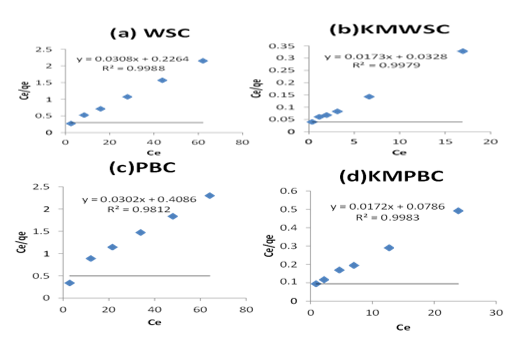
Fig 4: (A) Langmuir Models fitting for Adsorption of OG on (a)WSC, (b)KMWSC, (c) BPC, and (d) KMBPC sorbents
Table 1. Langmuir and Freundlich Adsorption Isotherm Models fitting
| Models |
Parameters |
WSC |
BPC |
KMWSC |
KMBPC |
|
Isotherm Langmuir model |
qm(mgg-1) | 33.12 | 33.32 | 58.78 | 58.70 |
| KL.(L.mg-1) | 0.129 | 0.069 | 0.529 | 0.220 | |
| R2 | 0.982 | 0.979 | 0.996 | 0.996 | |
|
Isotherm Freundlich model |
n | 2.661 | 1.829 | 2.189 | 1.991 |
| KF(L.mg-1) | 6.827 | 4.028 | 18.06 | 11.69 | |
| R2 | 0.945 | 0.819 | 0.921 | 0.949 |
Compared to commercial activated carbon, which typically exhibits Cr(VI) adsorption capacities in the range of 20–40 mg g⁻¹ under similar conditions, the performance of the modified banana peel (MBP) and modified wheat straw (MWS) is competitive, with capacities reaching 28.1 and 32.3 mg g⁻¹, respectively. In addition to their comparable adsorption efficiency, these agricultural waste-based adsorbents offer advantages in terms of lower cost, renewable sourcing, and environmental sustainability. Therefore, the materials developed in this study can serve as promising alternatives to conventional activated carbon in low-resource water treatment applications.
3.4 Adsorption of Orange G (OG) Dye on different prepared adsorbents
3.4.1 Effect of Contact Time on Adsorption of Dye
The adsorption experiment was carried out over a period ranging from 10-90 mint, with intervals of 10 mint respectively. After 80 mint for WSC, 50 mint for KMWSC and BPC, and 70 mint for KMBPC, equilibrium was attained. A pH of 4, temperature of 303K and 240 rpm were used in the adsorption procedure. The dye concentration was 80 mgL-1, and the adsorbent dosage was 2 gL-1. Figures 5 provide the experimental findings of the adsorption process conducted. After the first 50-60 mint, the sorption capacity (mgg-1) of dye OG on KMWSC is shown to grow, and then it stabilizes. Initially, a higher rate of adsorption was seen as a result of the existence of a larger number of active sites on the adsorbents [15-16], in conjunction with a high concentration of OG. There was not a significant change in the capacity of the adsorption process after 60 minutes, due to decrease in availability of surface-active sites. The sorption capacity of dye on WSC, KMWSC, BPC, and KMBPC was carried out, and the results showed that the values obtained at equilibrium stirring time were 25.9, 37.1, 22.56, and 37.35 mgg-1, respectively. Moreover, 64.20%, 95.01%, 56.50%, and 92.45% of the OG that was seen to be adsorbing on WSC, KMWSC, BPC, and KMBPC at equilibrium were observed. Both the sorption capacity (mgg-1) and sorption % of OG on KMWSC and KMBPC are significantly greater when compared to the comparable WSC and BPC, as shown by the outcomes of the adsorption evaluation.

Fig 5: Influence of time on sorption capacity (mgg-1) of OG on WSC, KMWSC, PBC then KMBPC.
3.4.2 Impact of “Adsorbent Dose” on the Adsorption of OG on Prepared Adsorbents
During the investigation into the adsorption properties of the adsorbents, a variable adsorbent dosage that ranged from 1 to 5 gL-1 was employed in 50 mL of an 80 mgL-1 dye solution at 303 K and a pH of 4 as shown in Figure 6. The figure demonstrates that the adsorption capacity (mgg-1) declined as the adsorbent dosage enhanced. The maximal adsorption capacity (mgg-1) for OG was determined to be 33.9 mgg-1 for WSC, 52.0 mgg-1for KMWSC, 26.9 mgg-1for BPC, and 46.0 mgg-1 for KMBPC, respectively, when the concentration of WSC was 1gL-1. In light of this, it seems that a high concentration of dye is present, which increases the absorption capacity measured in terms of mgg-1, even if there are only a few surface-active sites [17-18]. This was attributed to the increasing availability of active sites for a certain quantity of dye molecules. A dosage of 5gL-1 of adsorbent resulted in the highest percentage of OG removal [19]. A further increase in the concentration of the adsorbent has negligible effect on removal. At an adsorbent dosage of 5gL-1, the investigation indicated that the KOH-modified adsorbents (KMWSC & KMBPC) were capable of removing the OG dye from aqueous medium in a manner that was practically complete.

Fig 6: Influence of sorbent dosage on the removal % of OG on WSC, KMWSC, BPC and KMBPC.
3.4.3 Impact of pH on the Adsorption Characteristics of OG Dye
Within the range of 2 to 10, the research investigated the effect that the initial pH had on the adsorption of dye. The experiment showed that the initial pH increased, which increased the amount of dye that was absorbed by the adsorbents. When the pH was equal to 4, the amount of adsorption was at its greatest, and then it gradually decreased until it reached a value of 8. As can be seen in Figure 7, a considerable reduction was investigated when the starting pH was more than 8. When tested at a pH of 4, it was discovered that the maximal dye adsorption capacity of WSC, KMWSC, BPC, and KMBPC was 26 mgg-1, 38.4 mgg-1, 23.13 mgg-1, and 36.18 mgg-1, respectively. In the presence of the same pH circumstances, the percentages of OG that were absorbed by WSC, KMWSC, BPC, and KMBPC were measured as 65.1%, 96%, 57.6%, and 91.1%, respectively. At low pH values, the surfaces of sorbents get protonated, which increases their propensity for adsorbing anionic dye (OG). Because of the greatly increased proton concentration at very low pH levels, there is a possibility that the anionic dye may interact with the proton concentration, which will result in a decrease in the dye’s affinity for the sorbents [19]. Based on the findings of when the pH level is increased, the degree of protonation decreases, which results in a decreased dye adsorption value. In addition, when the pH level is raised, the concentration of hydroxide ions rises, which results in competition with the OG dye, which is an anionic dye. Based on the data, it can be concluded that the KOH-modified sorbents are capable of successfully removing almost all of (anionic dye) i.e., OG from the aqueous solution when the pH is changed to 4.

Fig 7: Impact of pH on sorption % of OG on WSC, KMWSC, BPC, and KMBPC.
The primary mechanism responsible for Orange G dye removal by KMBPC and KMWSC is electrostatic attraction between the negatively charged sulfonate groups of the dye molecules and the positively charged functional groups (e.g., protonated hydroxyl and carboxyl groups) present on the adsorbent surface. The FTIR results confirmed the presence of these functional groups after KOH modification. Additionally, π–π stacking interactions between the aromatic rings of Orange G and the graphitic carbon domains of the biochar may contribute to dye adsorption, particularly in the modified forms. Hydrogen bonding between surface –OH groups and dye molecules may also play a minor role. These combined interactions enhance dye uptake and explain the high adsorption efficiency observed.
3.5. Reusabilty Study
“The adsorbents showed moderate regeneration capacity over five cycles, with a gradual decrease in adsorption performance. MBP and MWS retained 71% and 76% of their initial adsorption capacities, respectively, after the fifth cycle. This decline may be attributed to partial blockage or loss of active sites, and possible structural degradation during desorption using ethanol. Despite this, the materials demonstrate acceptable reusability, making them promising candidates for practical wastewater treatment applications. Compared to traditional activated carbon, the production cost of KMBPC and KMWSC is significantly lower due to the use of freely available agricultural residues (banana peels and wheat straw) and the relatively mild processing conditions. While activated carbon requires high-temperature activation (700–900 °C) and energy-intensive equipment, our chars are produced at 400 °C with KOH as a low-cost activating agent. Additionally, the synthesis does not require advanced post-treatment or costly chemical reagents. These factors make KMBPC and KMWSC more affordable and environmentally friendly, offering a viable alternative for large-scale applications, especially in low-resource settings. Although a full life cycle or economic analysis was beyond the scope of this study, preliminary estimations suggest at least a 40–60% reduction in material and processing costs compared to commercial activated carbon.
Conclusion
Various forms of thermo-chemically modified sorbents derived from locally sourced wheat straw and banana peel, a cost-effective material, were effectively developed. KOH was utilized for the surface modification of sorbents derived from both residues and used for toxic dyes (OG ) removal from aqueous media. The findings from the sorption study demonstrated that the KOH-modified sorbents were capable of nearly complete removal of the OG, from aqueous media at dilute concentrations. The KOH-modified wheat straw and banana peel Char demonstrated the ability to eliminate 96% of OG dye from an 80mgL-1 water, achieving a sorption capacity of 38.40 mgg-1 at 303K. The KOH-modified wheat straw char demonstrated an impressive removal rate of 91.1% for OG dye from an 80 mgL-1 aqueous solution, achieving a sorption capacity of 36.45 mgg-1 at 303K. Isotherms models, including Langmuir and Freundlich, were applied to the sorption data. It was observed that the data generally aligns with both isotherm models; however, the correlation coefficients (R2) exhibited variability depending on the experimental conditions. It was additionally observed that the efficiency of adsorption, along with kinetics and thermodynamic behavior, may vary not only with the experimental conditions but also with the specific type of sorbent.
Author’s Contribution: R.A.A, Conceived the idea; S.B., Designed the simulated work and A.J.L., did the acquisition of data; L.A.Z., Executed simulated work, data analysis or analysis and interpretation of data and wrote the basic draft; A.J.L, Did the language and grammatical edits or Critical revision.
Funding: The publication of this article was funded by no one.
Conflicts of Interest: The authors declare no conflict of interest.
Acknowledgment: The authors would like to thank the advisors who advised for assistance with the collection of data.
REFERENCES
[1] R. M. Zakaria, I. Hassan, M. Z. El-Abd, and Y. A. El-Tawil, “Lactic acid removal from wastewater by using different types of activated clay,” in Thirteenth international water technology conference (IWTC), Hurghada, 2009, vol. 13, pp. 403–416.
[2] Z. Aksu, “Application of biosorption for the removal of organic pollutants: a review,” Process Biochem., vol. 40, no. 3–4, pp. 997–1026, 2005.
[3] R. Kant, “Textile dyeing industry an environmental hazard,” 2011.
[4] K. Anttha and S. N. Prasad, “Developing multiple natural dyes from flower parts of Gilmour,” Curr. Sci., vol. 92, p. 12, 2007.
[5] V. K. Gupta, A. Mittal, and V. Gajbe, “Adsorption and desorption studies of a water soluble dye, Quinoline Yellow, using waste materials,” J. Colloid Interface Sci., vol. 284, no. 1, pp. 89–98, 2005.
[6] R. Gunnarsdóttir, P. D. Jenssen, P. E. Jensen, A. Villumsen, and R. Kallenborn, “A review of wastewater handling in the Arctic with special reference to pharmaceuticals and personal care products (PPCPs) and microbial pollution,” Ecol. Eng., vol. 50, pp. 76–85, 2013.
[7] J. Abdi, M. Vossoughi, N. M. Mahmoodi, and I. Alemzadeh, “Synthesis of metal-organic framework hybrid nanocomposites based on GO and CNT with high adsorption capacity for dye removal,” Chem. Eng. J., vol. 326, pp. 1145–1158, 2017.
[8] E. F. C. Chaúque, L. N. Dlamini, A. A. Adelodun, C. J. Greyling, and J. C. Ngila, “Electrospun polyacrylonitrile nanofibers functionalized with EDTA for adsorption of ionic dyes,” Phys. Chem. Earth, Parts A/B/C, vol. 100, pp. 201–211, 2017.
[9] P. Russo, A. Frustaci, A. Del Bufalo, M. Fini, and A. Cesario, “Multitarget drugs of plants origin acting on Alzheimer’s disease,” Curr. Med. Chem., vol. 20, no. 13, pp. 1686–1693, 2013.
[10] C. HALIMA, D. KAMEL, B. OUALID, S. Tahar, and B. Abdelkader, “Decolourization of azo dye orange g by Fenton and photo-Fenton processes in aqueous solution,” Int. J. Chem. Sci, vol. 6, pp. 619–630, 2008.
[11] O. I. Lipskikh, E. I. Korotkova, Y. P. Khristunova, J. Barek, and B. Kratochvil, “Sensors for voltammetric determination of food azo dyes-A critical review,” Electrochim. Acta, vol. 260, pp. 974–985, 2018.
[12] B. Zhao, W. Xiao, Y. Shang, H. Zhu, and R. Han, “Adsorption of light green anionic dye using cationic surfactant-modified peanut husk in batch mode,” Arab. J. Chem., vol. 10, pp. S3595–S3602, 2017.
[13] S. M. Hussein, O. H. Shihab, and S. S. Ibrahim, “Interaction between Kaolin and DMSO: FTIR, XRD, thermodynamic and Nano studies,” J. Univ. Anbar Pure Sci., vol. 8, no. 1, 2014.
[14] S. M. Hussein, O. H. Shihab, and S. S. Ibrahim, “Interaction between Kaolin and DMSO : FTIR , XRD , thermodynamic and Nano studies,” vol. 8, no. 1, pp. 31–37, 2014.
[15] M. He, R. Zhou, and X. Guo, “Behavior of stabilized multiwalled carbon nanotubes in a FeCl3 coagulation system and the structure characteristics of the produced flocs,” J. Colloid Interface Sci., 2012.
[16] A. F. M. M. Santos et al., “Hybrid self-assembled materials constituted by ferromagnetic nanoparticles and tannic acid: A theoretical and experimental investigation,” J. Braz. Chem. Soc., vol. 27, no. 4, pp. 727–734, 2016.
[17] Y. Sun, W. Sun, K. J. Shah, P. C. Chiang, and H. Zheng, “Characterization and flocculation evaluation of a novel carboxylated chitosan modified flocculant by UV initiated polymerization,” Carbohydr. Polym., 2019.
[18] M. E. M. Ali, H. Abdelsalam, N. S. Ammar, and H. S. Ibrahim, “Response surface methodology for optimization of the adsorption capability of ball-milled pomegranate peel for different pollutants,” J. Mol. Liq., vol. 250, pp. 433–445, 2018.
[19] W. Sun, S. Zhou, Y. Sun, and Y. Xu, “Synthesis and evaluation of cationic flocculant P(DAC-PAPTAC-AM) for flocculation of coal chemical wastewater,” J. Environ. Sci. (China), 2021.